
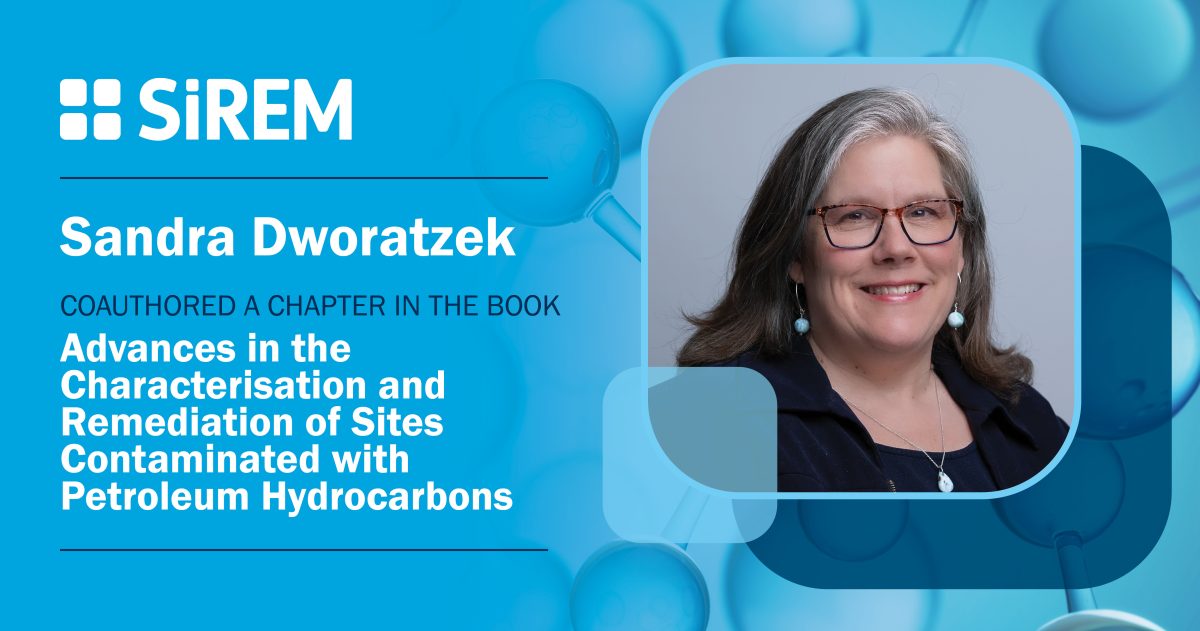
SiREM’s Sandra Dworatzek (Ontario) coauthored a chapter titled “Bioremediation of Petroleum Hydrocarbons in the Subsurface” in the book, Advances in the Characterisation and Remediation of Sites Contaminated with Petroleum Hydrocarbons, published by SpringerLink.
Sandra’s coauthors were Sarah M. Miles and Ron Gestler of Geosyntec.
Sandra is a Principal Scientist at SiREM Lab with more than 25 years of experience in bioremediation of chlorinated solvents, petroleum hydrocarbons, emerging contaminants and other recalcitrant compounds. She has specific technical experience in designing laboratory treatability studies, evaluating aerobic and anaerobic bioremediation, zero valent iron and chemical oxidation technologies in the laboratory, and the scale up of growth of aerobic and anaerobic microbial cultures for bioaugmentation laboratory and field pilot tests. She currently provides senior technical oversight of laboratory treatability studies, and she develops and scales up new bioaugmentation cultures. This work includes developing novel cultures for BTEX compounds under anaerobic conditions and developing aerobic cultures to remediate 1,4-dioxane. Sandra is the industry lead for a project funded by Genome Canada that aims to commercialize anaerobic BTEX-degrading cultures.
This book is part of the book series, Environmental Contamination Remediation and Management, from SpringerLink, a group of book series published under Springer. SpringerLink delivers fast access to the depth and breadth of our online collection of journals, eBooks, reference works and protocols across a vast range of subject disciplines. SpringerLink is the reading platform of choice for hundreds of thousands of researchers worldwide.
About the Book
Advances in the Characterisation and Remediation of Sites Contaminated with Petroleum Hydrocarbons synthesizes important advances in the assessment and management of soil and groundwater systems contaminated with petroleum hydrocarbons, especially in the form of light nonaqueous-phase liquids (LNAPLs). LNAPL characterization and remediation is challenging due to the multi-phase, multi-component nature of the problem and the various physical, chemical, and biological processes involved in a dynamic and heterogeneous hydrogeological setting. This book focuses on the current state of practice of LNAPL characterization and remediation, and it seeks to provide information and a framework that would allow some of these complexities to be better addressed by contaminated land practitioners, researchers, and regulators.
Chapter Abstract
Due to human activity and, to a lesser extent, natural processes, petroleum hydrocarbons continue to pollute the environment. These contaminants of concern can be found globally, and their remediation is key to restoring affected sites to a safe and functional status. Conventional treatment of sites contaminated with petroleum hydrocarbons relies heavily on remediation approaches that are often financially prohibitive or may be technically impractical and approaches that sometimes produce undesirable by-products. Using microbes that occur in nature (if not always at the site) can be a viable treatment with distinct advantages. Understanding the environment, contaminants, and natural biological processes occurring are key aspects for effective application of remediation techniques that rely on biological processes. Whether by stimulating the native microbial community, or, secondarily, by augmenting the native community with known degrader populations to degrade the target compounds, bioremediation is a practical, effective, and sustainable natural solution to a wide array of contamination worldwide. This chapter explores approaches to bioremediation of both soil and groundwater contaminated by petroleum hydrocarbons, describing how the approaches work and the benefits and challenges associated with them. It focuses on the use of aerobic and anaerobic microbial bioremediation, phytoremediation, and micoremediation to address petroleum hydrocarbons.
More Information
Learn more about the chapter: Bioremediation of Petroleum Hydrocarbons in the Subsurface
Learn more about the book: Advances in the Characterisation and Remediation of Sites Contaminated with Petroleum Hydrocarbons
For a consultation regarding bioremediation of petroleum hydrocarbons, contact Sandra Dworatzek at SDworatzek@siremlab.com.

