1,4-Dioxane a Challenging but Treatable Contaminant
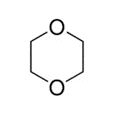 1,4-Dioxane is a well-known emerging contaminant that has garnered attention for well over a decade. The chemical properties that made it attractive for use as an industrial chemical include structural stability, low volatility, and not being readily adsorbed to organic carbon. These properties combined with inadvertent losses and spills have resulted in the formation of large, diffuse groundwater plumes that have contaminated drinking water supplies for millions of people around the world.
Due to its chemical properties, remedial approaches such as pump-and-treat, air stripping, and soil vapor extraction are generally ineffective for 1,4-dioxane remediation. Biodegradation under aerobic conditions, either by direct metabolism or co-metabolism, is a viable approach. At sites where 1,4-dioxane-degrading bacteria are present, degradation may occur naturally and can be enhanced by injecting oxygen and cometabolites such as methane. If 1,4-dioxane-degrading bacteria are absent they can be introduced through bioaugmentation.
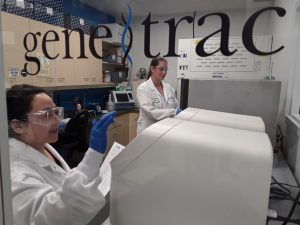 Metabolic aerobic biodegradation of 1,4-dioxane has been well studied. Mahendra and Alvarez-Cohen (2006) identified dioxane monooxygenase (dxmB) as the enzyme responsible for the initial cleavage of 1,4-dioxane, while aldehyde dehydrogenase (ALDH) breaks down intermediates, ultimately producing carbon dioxide. There are various monooxygenase enzymes like particulate methane monooxygenase (pMMO), propane monooxygenase (PMO), and toluene monooxygenase (TMO) that enable cometabolic aerobic biodegradation of 1,4-dioxane. Molecular biological tools for 1,4-dioxane targets include Gene-Trac® 1,4-Dioxane (dxmB and ALDH) and tests for cometabolic pathways, Gene-Trac® pMMO, PMO and TMO.
In general, 1,4-dioxane biodegradation rates may be slow relative to other aerobic degradation processes. This may result from low initial 1,4-dioxane concentrations and low biomass of 1,4-dioxane degrading microbial populations (Barajas-Rodriguez and Freedman 2018). Cometabolic approaches may be more suited to low concentration plumes, whereas ex situ reactors can enhance metabolic degradation, by providing a steady source of 1,4-dioxane to metabolic degraders. 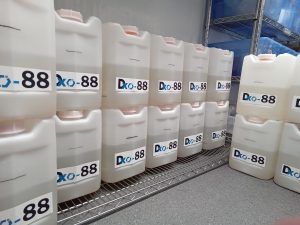
SiREM has identified and scaled up a 1,4-dioxane degrading culture, DXO-88, capable of complete aerobic biodegradation of 1,4-dioxane. The DXO-88 culture contains both metabolic and cometabolic 1,4-dioxane degraders and is available for field bioaugmentation use. Prior to field application, bench scale microcosm and column testing can be used to test the cultures effectiveness under site specific conditions and contaminant mixtures.
For more information on SiREM’s DXO-88 culture, or services for monitoring and optimizing 1,4-dioxane remediation please reach out to contactsirem@siremlab.com.